How to Cut Cardboard Cleanly: Tools, Grain and Safe Technique
Learn which tool suits corrugated and cereal box card, why the direction of the ribs matters, and how to make straight cuts, scored folds, curves and windows with clean edges.

Ragged edges, crushed ribs and cuts that drift off the line are the usual complaints from anyone learning how to cut cardboard. Almost all of them come from three things: the wrong tool for the type of card, too much pressure, and a dull blade.
This guide covers the two kinds of cardboard you will meet most often, the direction of the corrugation, and the technique for straight cuts, folds, curves and windows.
Know your cardboard: corrugated and chipboard
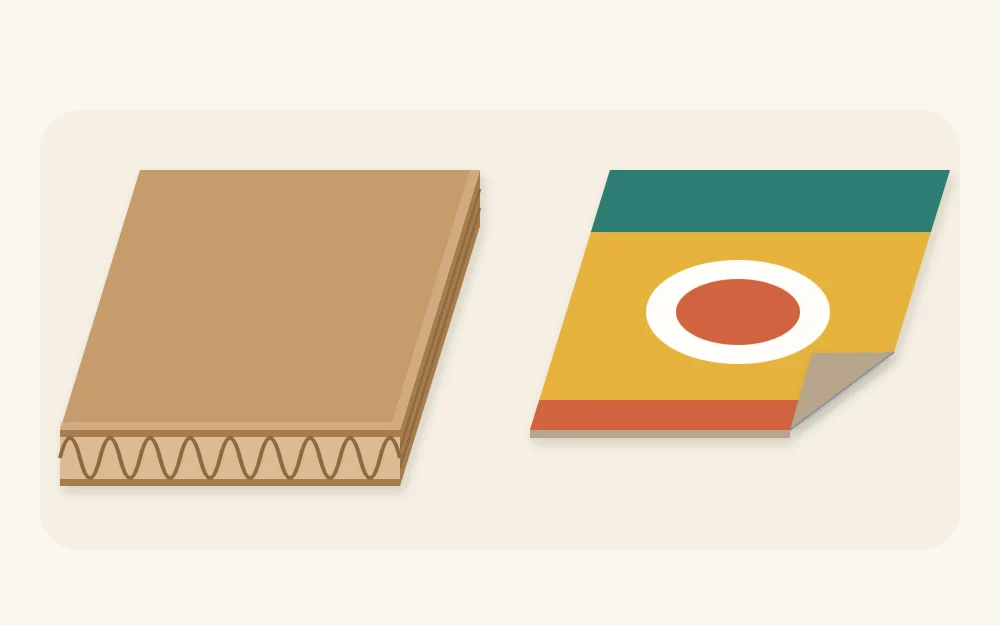
Corrugated cardboard is the material of shipping boxes: a wavy middle layer glued between two flat paper liners. It is thick, light and stiff for its weight, but it crushes if you press on it and its edges show the ribs.
Chipboard is the thin, solid card of cereal, cracker and tissue boxes. It has no hollow layer, so it cuts easily with scissors, folds anywhere and gives a smooth edge, but it bends under load.
| Cardboard type | Best tool | Typical use |
|---|---|---|
| Cereal box card (chipboard) | Scissors; craft knife for windows | Gift boxes, tags, templates, notebook covers |
| Single-wall corrugated | Craft knife and metal ruler | Frames, dividers, wall panels, trays |
| Double-wall corrugated | Sharp knife, many light passes | Bases and backings that need stiffness |
Find the direction of the corrugation
Look at a cut edge of corrugated cardboard and you will see the ends of small tunnels. Those tunnels, often called the grain, run in one direction across the whole sheet, and that direction changes how the cardboard behaves.
- Folding: the sheet folds easily and neatly along the ribs. Across them it resists and tends to crease in a wobbly line unless you score it first.
- Strength: a strip stands up best when the ribs run from its bottom edge to its top edge, like small columns. A strip with ribs running along its length flexes much more.
- Cutting: cuts across the ribs need more passes. Cuts along them are easy, but the blade can slip into a groove and follow it, so keep it tight against the ruler.
Before marking out any project, decide which way the ribs should run in each part and draw a small arrow on the sheet as a reminder.
Scissors or craft knife?
Scissors are right for cereal box card, for trimming, and for rough cuts that break a box down into flat panels. On corrugated cardboard they squeeze the layers together as they cut, which leaves a pinched edge.
A craft knife slices downward without squeezing, so it gives a square edge on corrugated board and is the only neat way to cut inside shapes. It needs a self-healing cutting mat and a metal ruler; a plastic ruler gets shaved by the blade and lets it ride up over the edge. The basic tools starter kit explains what each of these is for and which ones can wait.
Straight cuts: several light passes
- Mark the line with a sharp pencil at two points and join them with the ruler.
- Lay the metal ruler on the part you want to keep, so a slip only damages the offcut.
- Press the ruler down with your fingertips spread, well back from the cutting edge.
- Hold the knife at a low angle and draw it toward you along the ruler with light pressure. The first pass only cuts the top liner.
- Repeat in the same groove. Single-wall cardboard usually takes three or four passes.
- Stop when the piece falls free. Do not tear the last fibers; make one more pass instead.
Light passes are safer as well as neater. A blade forced through in one push is the one that jumps the ruler.
Watch out
Keep the hand that holds the ruler out of the blade’s path, cut away from that hand, and stand so the knife is not traveling toward your body. Cap or retract the blade whenever you put it down. When crafting with children, an adult does the knife steps.
Scoring for clean folds
Scoring means pressing or lightly cutting a line so the cardboard folds exactly there.
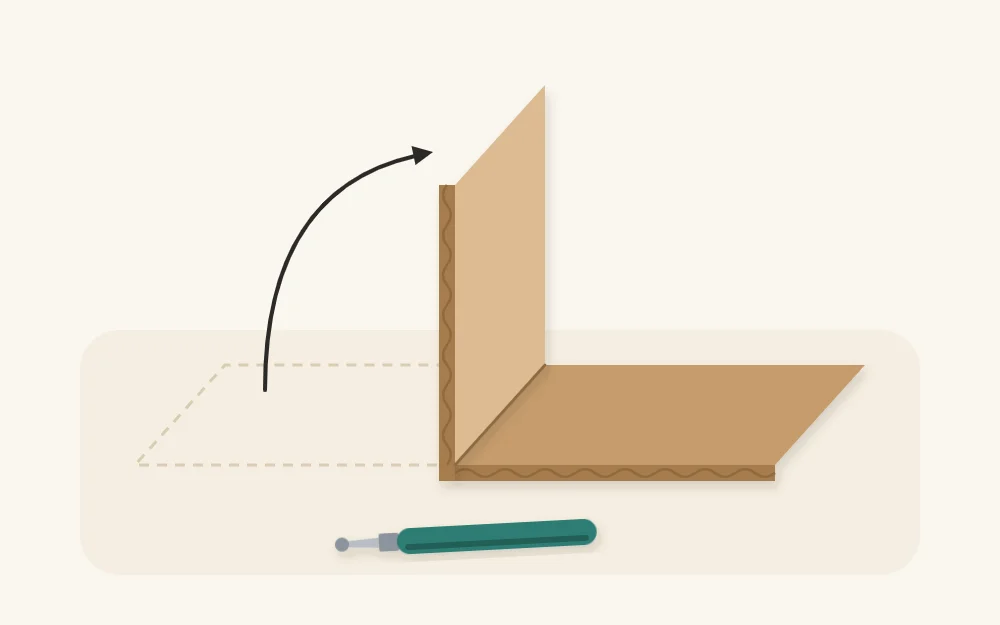
For cereal box card, run a blunt point along the ruler: an empty ballpoint pen, a butter knife or the back of a scissor blade. Press firmly enough to leave a groove, then fold with the groove on the outside of the bend.
For corrugated cardboard, either crush a line with the same blunt tool or make a single light knife pass that cuts only the top liner. Fold away from the cut so it opens along the outside of the corner. The lower liner acts as the hinge, so do not cut into it.
Curves, circles and windows
For curves, trace a round object or template in pencil, then cut freehand with the knife in short, light strokes. Turn the cardboard with your free hand so the blade always moves in a comfortable direction. Expect more passes than on a straight line, and tidy the edge afterward with scissors or fine sandpaper.
For a window, such as the opening of a cardboard picture frame, cut each side from the corner inward and stop exactly at the next corner. Overcuts at the corners are the most visible flaw in a frame, so finish each corner with the tip of the blade and lift the center out only when all four sides are fully cut.
Narrow slots, like the interlocking ones in cardboard drawer dividers, are two parallel cuts joined by a short cut across the end.
Blades, table and fingers
A dull blade tears paper fibers instead of slicing them and needs more force, which makes slips more likely. Cardboard dulls blades quickly because of the fillers and glue in it. Change or snap off the blade when the top liner starts to drag or fray, and wrap used blades in tape before throwing them away.
Always cut on a cutting mat. If you do not have one yet, a thick piece of scrap corrugated cardboard under the work will protect the table for a few cuts, though the blade wanders more on it.
Tip
Cut a little outside the line on a scrap first whenever you start on a new box. Cardboard varies in thickness and density, and one test cut tells you how many passes it needs.
Frequently asked questions
Why does my cardboard edge look crushed after cutting?
Crushed edges usually come from scissors, a dull blade or pressing too hard. Scissors squeeze the hollow layer of corrugated cardboard as they close. Switch to a craft knife with a fresh blade and make several light passes along a metal ruler so the blade slices each layer in turn.
Can you cut corrugated cardboard with scissors?
You can for rough work, such as breaking a box into flat panels or trimming a corner. For edges that will show, scissors tend to pinch the layers and leave a slightly bent line. A craft knife on a cutting mat gives a square, cleaner edge, especially on long straight cuts.
How do you fold thick cardboard without it cracking?
Score the fold line first. Press a groove with a blunt tool along a ruler, or make one light knife pass through only the top paper layer, then fold away from that line. Folding along the ribs is easier than across them, so plan folds with the corrugation direction where you can.